Introduction: Why CNS Drug Delivery Is So Difficult
The central nervous system (CNS) is one of the most sophisticated and tightly regulated biological systems in the human body. It controls essential physiological functions, cognitive processes, and neural communication. Because of this complexity, even minor disruptions such as neurodegenerative diseases, brain tumors, or traumatic injuries—can have severe consequences.
Treating CNS disorders requires delivering therapeutic agents directly to affected brain tissues. However, this is far from straightforward. One of the primary obstacles is the blood–brain barrier, a highly selective biological barrier that protects the brain from harmful substances circulating in the bloodstream.
While the BBB is essential for maintaining brain homeostasis, it also severely limits the entry of most drugs. As a result, many potentially effective therapies fail because they cannot reach therapeutic concentrations in the brain.
This creates a dual challenge:
- Developing effective CNS-targeted drugs
- Designing innovative delivery systems capable of bypassing or crossing the BBB
Understanding the Blood–Brain Barrier (BBB)
Structure and Function
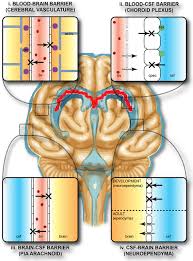
The BBB is a complex, multi-layered structure composed of:
- Endothelial cells with tight junctions
- Basement membrane
- Pericytes
- Astrocyte endfeet
These components work together to create a highly selective permeability system, allowing only specific molecules to pass through.
Small, lipophilic molecules such as oxygen (O₂), carbon dioxide (CO₂), and water can diffuse freely. In contrast, most drugs especially large or hydrophilic compounds are effectively blocked.
Transport Mechanisms
The BBB regulates molecular entry using:
- Passive diffusion (for small lipophilic molecules)
- Carrier-mediated transport (CMT) for nutrients like glucose and amino acids
- Receptor-mediated transport (RMT) for larger biomolecules such as insulin
Despite these mechanisms, less than 1% of systemically administered drugs typically reach the CNS, highlighting the need for alternative delivery strategies.
Several biological and pharmacokinetic barriers complicate CNS drug delivery:
- First-pass metabolism, reducing drug bioavailability
- Peripheral tissue uptake, limiting drug reaching the brain
- Efflux transporters (e.g., P-glycoprotein), actively removing drugs from the CNS
- BBB impermeability, blocking most therapeutic molecules
These challenges demand advanced delivery systems that can selectively target brain tissues while minimizing systemic side effects.
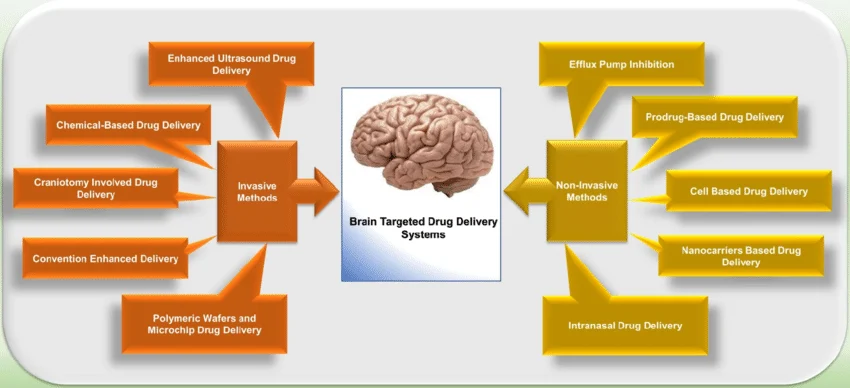
CNS drug delivery approaches are broadly classified into two categories:
1. Invasive Drug Delivery Methods
These techniques involve direct physical access to the brain or temporary disruption of the BBB.
Direct Intracranial Injection
This method delivers drugs directly into brain tissue using surgical techniques. While highly targeted, it is:
- Limited by diffusion (only a few millimeters)
- Invasive and risky
- Not suitable for chronic conditions
Modulating BBB Permeability
Another invasive strategy involves temporarily opening the BBB.
Osmotic Disruption
- Uses agents like mannitol
- Causes endothelial cell shrinkage
- Opens tight junctions
Limitation: Poor spatial control and potential toxicity.
Ultrasound-Mediated BBB Disruption
A more precise method uses:
- Microbubbles + ultrasound waves
Mechanism
- Microbubbles oscillate under ultrasound
- Mechanical force opens BBB temporarily
- Drugs enter targeted brain regions
Advantages
- Non-permanent BBB opening
- High spatial precision
- No need to chemically modify drugs
Limitations
- Risk of tissue damage at high microbubble concentrations
- Still largely in preclinical development
Optical (Laser-Based) BBB Modulation
This emerging technique uses near-infrared laser pulses to:
- Temporarily increase BBB permeability
- Enable localized drug delivery
Challenges
- Limited tissue penetration (~1 mm)
- Potential oxidative stress and cellular damage
Convection-Enhanced Delivery (CED)
CED is an advanced invasive technique that improves drug distribution within the brain.
How it works
- A catheter is inserted into the brain
- Drugs are infused under positive pressure
- This creates bulk flow, allowing deeper tissue penetration
Advantages
- Uniform drug distribution
- Higher local drug concentration
- Reduced systemic toxicity
Applications
- Brain tumors (e.g., glioblastoma)
- Epilepsy
- Neurodegenerative diseases
CED has shown promising results in both preclinical and clinical studies, demonstrating controlled drug delivery with minimal damage.
2. Non-Invasive Drug Delivery Methods
Non-invasive approaches aim to:
- Avoid surgery
- Improve patient compliance
- Enable long-term treatment
Chemical Strategies: Prodrug Design
A prodrug is an inactive compound that becomes active after metabolic conversion.
Lipidization
Increasing lipophilicity improves BBB penetration.
Example:
- Morphine → Heroin (enhanced BBB permeability)
Limitations
- Premature activation outside the brain
- Increased systemic toxicity
- Poor targeting specificity
Transporter-Targeted Drug Delivery
Drugs can be engineered to exploit BBB transport systems:
LAT1 (Amino Acid Transporter)
Used by:
- L-DOPA (Parkinson’s treatment)
GLUT1 (Glucose Transporter)
Drugs conjugated with glucose can:
- Cross BBB efficiently
- Reach brain tissues
Intranasal Drug Delivery (IDD)
A highly promising non-invasive method.
Mechanism
- Drug enters via olfactory epithelium
- Bypasses BBB entirely
- Travels along olfactory and trigeminal nerves
Advantages
- Rapid brain delivery
- No first-pass metabolism
- Easy administration
Applications
- Alzheimer’s disease (intranasal insulin)
- Autism (oxytocin therapy)
- Parkinson’s disease
Limitations
- Only certain molecules can pass
- Limited absorption capacity
Biological and Nanotechnology-Based Approaches
Nanoparticles in CNS Drug Delivery
Nanotechnology enables targeted, controlled drug delivery.
Types of Nanocarriers
- Polymeric nanoparticles
- Lipid-based nanoparticles
- Magnetic nanoparticles
- Dendrimers and nanogels
Advantages
- Enhanced BBB penetration
- Controlled drug release
- Targeted delivery
- Reduced systemic toxicity
Cell-Penetrating Peptides (CPPs)
Also known as “Trojan peptides”, these molecules:
- Cross cell membranes easily
- Deliver drugs, DNA, or proteins inside the cell
Key Features
- Rich in arginine and lysine
- Highly efficient intracellular delivery
Applications
- Stroke treatment
- Neuroprotection
- Cancer therapy
Limitations
- Lack of specificity
- Possible immune reactions
- Enzymatic degradation
Current Limitations and Safety Concerns
Despite major advances, several challenges remain:
- Potential toxicity of nanoparticles
- Immune responses to peptide carriers
- Limited targeting specificity
- Long-term safety concerns
- Risk of BBB damage in invasive methods
Conclusion
The development of effective CNS drug delivery systems remains one of the most critical challenges in modern medicine. While traditional approaches have limitations, emerging technologies are transforming the field.
Key takeaways:
- No single method is universally effective
- Invasive techniques offer precision but carry risks
- Non-invasive approaches improve safety and compliance
- Nanotechnology and biological systems represent the future
Ultimately, the most successful strategies will likely combine:
- Targeted delivery
- Controlled release
- Minimal invasiveness
Continued research is essential to develop safe, efficient, and clinically applicable CNS drug delivery systems, enabling better treatment outcomes for neurological diseases.